Max Lawson
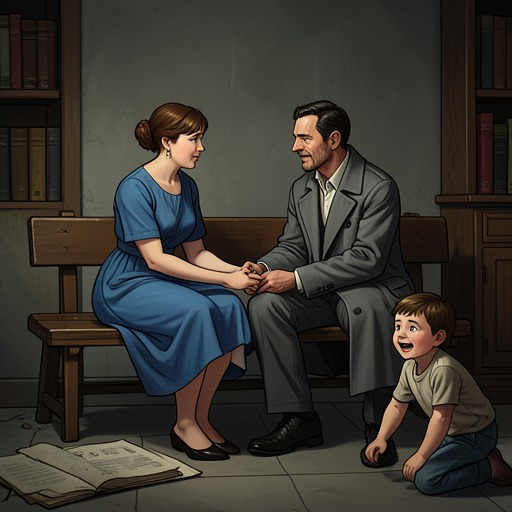
Just One LookMax Lawson, the son of Grace Lawson and Jack Lawson, is one of the clearest measures of what Jack’s absence means in ordinary family life. He asks whether his father can still see him, wants to revive a bath-time game they shared, and brings Jack into questions about soccer and school. Unlike his sister Emma Lawson, who withdraws from memories of their father, Max keeps speaking of him; his laughter, in turn, makes the past audible in the present.
Identity and Place in the Family
Max appears as a child closely attached to both parents and especially to the small routines he shared with Jack. The evidence introduces him in direct, practical moments rather than through a separate account of his background: he calls for Grace’s attention, hurries to greet Cram at the family’s doorstep, and later asks his mother to help him make sense of his father’s absence. These glimpses establish a child whose concerns are concrete, but whose questions reach beyond what Grace can confidently answer.
His place in the family becomes most distinct through contrast with Emma. In the aftermath of Jack’s death, Max talks about his father and asks questions, while Emma does not discuss Jack, seek out photographs, or reminisce. The difference does not mean that one child is grieving and the other is not. Grace sees signs of pain in Emma’s changed habits, but Max’s grief has a more audible form: he asks, remembers, and seeks reassurance.
Encounters at Home
When Grace, Emma, and Max return home, Cram is waiting on the front stoop. Max runs ahead, stops in front of him, and looks up before greeting him. He then asks whether all of Cram’s friends call him Cram. The exchange gives Max an uncomplicated curiosity about the imposing visitor: he approaches and talks to him rather than hanging back. Later, Cram is in the kitchen with both children, eating fish sticks with them while the peas go untouched. Emma reads a poem aloud, and Cram proves an enthusiastic audience. Max is present in this shared domestic scene, among the ordinary details that make the house feel lived in despite the danger and uncertainty surrounding the family.
On another occasion, Grace prepares to take both children for a ride. They grab their Game Boys and climb into the back of the car. The moment is brief, but it places Max within the routines Grace maintains while trying to protect her children and manage what they know. Her parenting involves decisions about what to disclose and what to conceal; the children’s presence in the car makes clear that those choices shape family life, not just Grace’s private investigation.
A Child’s Connection with Carl Vespa
Max’s interests also create a point of contact between Grace and Carl Vespa. When Carl recalls that his son Ryan was six and liked baseball cards, Grace responds that Max likes Yu-Gi-Oh! The exchange moves from Carl’s memory of Ryan to a concrete detail about Max, allowing the two children to be connected through the small enthusiasms of childhood without suggesting that their lives or circumstances are identical. Max’s interest is specific enough to make him present in a conversation otherwise shaped by loss: Grace answers not with an abstract description of her son, but with the game that currently occupies him.
Grief After Jack’s Death
After Grace is hospitalized, her children visit briefly. She wants them to see that she is all right, that she is safe, and that they are safe. She changes into regular clothes rather than greeting them in a hospital gown and takes a strong pain injection to quiet the pain in her ribs. Max is part of this visit, though the account does not single out a particular response from him. The scene instead shows the protective effort surrounding both children: Grace tries to present reassurance even while seriously hurt.
Later, Max’s grief takes a more direct form. He likes to talk about Jack and asks where his father is, what heaven is like, and whether Jack can still see them. He wants assurance that his father can observe important moments in his young life. Grace tries to answer as best she can, but her explanations feel hollow even to her. The questions are not confined to death as an abstract subject; Max wants to know whether the relationship continues to include the events of his own growing-up.
A shared bath-time ritual gives that longing a familiar shape. Max wants Grace to make up Jenny Jenkins rhymes with him, as Jack used to do. When she does, Max laughs, and the sound resembles Jack’s so strongly that Grace feels her heart might burst. The rhyme lets a piece of their old family routine continue, but it also makes the absence more acute: Jack’s remembered presence returns through the child who sounds like him, not through any certainty that Jack is listening.
The Future He Still Wants to Share
Even after Jack’s death, Max brings his father into ordinary choices. He wants to sign up for the Kasselton traveling soccer team, and Grace wonders whether he is too young for that commitment. She also thinks about whether Emma should enter an accelerated English program and whether the family should still go to Disney World in February. In the late-night conversations she imagines having with Jack, these practical questions sit beside the more painful one about Emma’s tears. Max’s soccer decision therefore belongs to a larger pattern: Grace continues to picture parenting as something she and Jack ought to consider together, while trying to make the decisions alone.
Max’s role in the family’s aftermath is not to resolve its grief but to give it an ongoing, everyday voice. His questions about heaven, his wish to be seen by his father, his remembered rhymes, and his plans for soccer each return Jack to the present in a different way. Against Emma’s silence, Max’s openness makes the children’s differing responses unmistakable; against Grace’s uncertainty, his questions show how loss persists not only in memories of the past but in the ordinary future a child still hopes to share with his father.